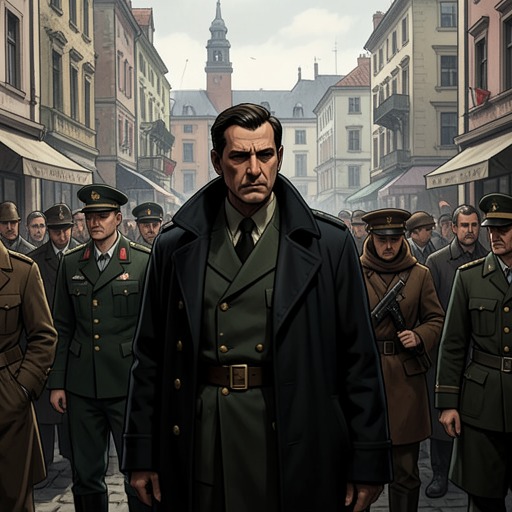
Sudeten Crisis
The Glass RoomThe Sudeten Crisis is the turning point at which the threat of war ceases to be a distant political argument and becomes a force reshaping the Landauers’ daily lives and the future of Czechoslovakia. Its progression—from troops massing at the border, through the appeasement speech heard at home, to the country’s partition and collapse—reveals how public assurances of peace can accompany the dismantling of a state. The novel makes that reversal concrete in the contrast between the Glass Room, initially a refuge for reason and calm, and the crisis gathering beyond its walls.
Mounting Danger and Private Denial
Viktor reads the warning signs as an immediate danger. The Sudeten German Party is making what he calls absurd demands, the Hitler government is encouraging them, and German troops are massing on the border. He urges Liesel to read the news and says war could come within days. Liesel answers that she does read the papers; Viktor retorts that she reads only the fashion pages. Their exchange stages the crisis inside the marriage: his alarm meets her refusal or inability to treat political reporting as a threat to their personal world.
The danger soon enters the Landauers’ domestic conversations more insistently. Oskar describes events as a matter of historical perspective: the people of the country had believed after the previous war that they had reached the culmination of a historical process, he argues, but they were only in its middle, unable to know where it would end. Around him and Viktor, the signs are specific and accumulating—riots in the border areas, German-speaking groups demanding autonomy, troops massing along the Austrian border, and competing cries for rights, independence, and secession. The uncertainty is not an absence of evidence; it is the inability to see what the evidence will become.
Marienbad: The Crisis in Public View
During that summer, the Czechoslovak army becomes Landauer Motors’ largest customer. The company supplies military vehicles, including Popular cars adapted for army use, while one production line is reassigned to lorry manufacture. The business’s new military role runs alongside the family’s holiday at the Hotel Fürstenhof in Marienbad. For a week, fine weather, crowded promenades, and music by Strauss sustain an illusion of an older, settled world. But political signs break into this carefully maintained holiday: graffiti calls for Anschluss, flags in the spa gardens bear the red and black of the Sudetenland, and on a drive to the monastery at Teplá, the family encounters army trucks moving toward the border.
The danger becomes impossible to treat as background when a parade of young people passes directly below the family’s rooms. Men in lederhosen and women in dirndls march beneath a banner bearing the slogan “Ein Volk, ein Reich, ein Führer,” singing “Die Fahne hoch! Die Reihen fest geschlossen!” An encounter with police ends in shouting and a scuffle, and the banner is smashed, but the procession continues while people along the road cheer. When Martin asks whether the soldiers will fight, Viktor says they are only on manoeuvres. Later, Liesel asks what will happen, and Viktor snaps that he has no way of knowing. The next morning, the town is daubed with swastikas. Reassurance and uncertainty have not halted the visible advance of Nazi power.
The Broadcast and the Meaning of a “Small Issue”
The crisis enters the home through a radio broadcast in English. Oskar understands little of the language, while Liesel initially misunderstands a phrase and asks whether the danger has passed. The speaker describes the burden of responsibility and the prospect of trenches and gas masks, then characterizes the conflict as a quarrel in a faraway country among people unknown to his listeners. His words present the transfer of territory as something that can still be arranged by agreement and under conditions meant to ensure fair treatment. The calm, careful language becomes a form of distance from the people whose country is at stake.
Hana recognizes the insult and its implication before the speech has ended. She cries in disbelief, asks for the radio to be turned off, and says that the people being discussed are them: a small issue, people of whom the distant powers know nothing. Oskar tries to comfort her, but she continues to cry. The episode gives the political crisis a personal measure: the diplomatic language that reduces a country to a problem also reduces its inhabitants to abstractions, while Hana insists on the human identity concealed by that rhetoric.
Dismemberment and the End of the Republic
The narration renders the autumn’s settlement as the dismemberment of a body, distinguishing the surgeon’s controlled cutting from the mad axeman’s frenzy but emphasizing that both produce the same result. The Great Powers witness the country being cut apart. The Czechoslovak army stands down as German troops enter Eger, Karlsbad, Teplitz, and Liberec. Poland takes part of Czech Silesia, and Hungary takes parts of Slovakia. The metaphor turns the apparently formal redrawing of borders into a physical image of a state losing its parts, while refusing to make the method of partition seem less destructive because it is orderly.
Refugees flee ahead of the advancing armies, pushing handcarts and carrying bundles along crowded roads and trains. The country experiences the effects of war without the fighting, a rehearsal for what is to come. By the end of autumn, the Republic of Czechoslovakia has ceased to exist; the truncated successor, CzechoSlovakia, is described as having only a very brief life ahead. Oskar invokes the legend of Good King Wenceslas, sleeping with his knights beneath Blaník Hill until called to save the homeland. Viktor rejects the prospect of miraculous rescue: the twentieth century, he says, is no time for miracles.
A House Recast by History
The crisis also belongs to the longer history of Landauer House. Before the political order collapses, its inhabitants experience the house as shelter: the Glass Room offers reason and calm while the world outside their lives crumbles. But the security of the modernist home proves provisional. The house’s construction had itself been marked by delays, material and workforce problems, and months of argument, even as the baby grew through milestones from grasping and recognizing her parents to raising herself and laughing. That parallel between a family’s growth and the building’s gradual completion gives domestic life a measured continuity that the political crisis will interrupt.
After the Landauers are displaced, the building’s spaces acquire uses imposed by new regimes and later generations. Under Nazi occupation, the house is transformed into offices and laboratories: the kitchens are adapted for laboratory work, a basement room is prepared for an X-ray machine, and the Glass Room is divided by curtains and equipped for anthropometric measurement and photography. The onyx wall remains as a backdrop to a new institutional purpose. In a later period the house serves as a children’s gymnasium, and in 1990 it is preserved as an architectural landmark, repaired and furnished with some objects returned from the Moravian Museum. The succession from family home to coercive institution, public facility, and heritage site gives the crisis consequences beyond the immediate loss of the Republic: political power repeatedly changes what the house is for, while its architecture continues to bear traces of the lives and histories it contains.